


Italy’s Battery and EV Supply Chain: Can It Compete in Europe?
- 20 March 2026
- Posted by: Narissra Ramangkool
- Category: News
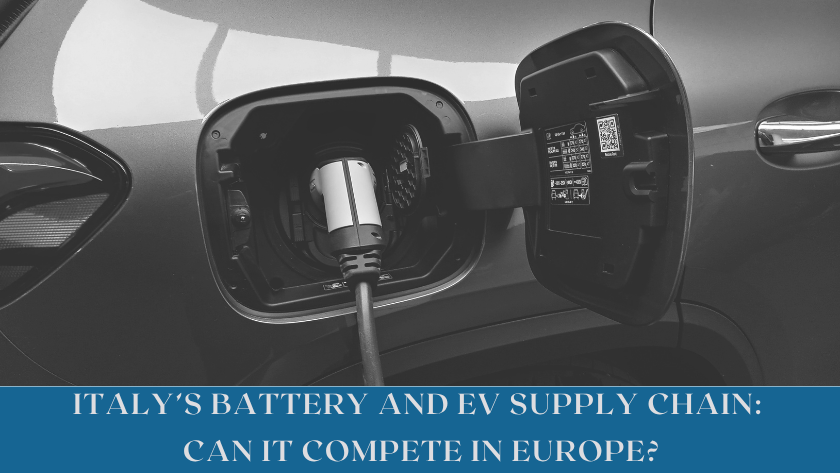
As Europe accelerates its transition toward electric mobility, the race to build a competitive and self-sufficient electric vehicle (EV) supply chain has intensified. Driven by ambitious decarbonization targets and industrial policy initiatives led by the European Commission, the European Union aims to significantly reduce its dependence on external suppliers, particularly from China, which currently dominates global battery production with over 70% of capacity.
At the same time, recent volatility in global energy markets has reinforced the urgency of this transition. Fluctuations in oil prices and broader supply uncertainties have highlighted the importance of energy diversification, further accelerating Europe’s push toward electrification and supply chain resilience.
Within this evolving landscape, Italy is seeking to define its role. While not among Europe’s leaders in large-scale battery manufacturing, the country is positioning itself as a strategic player in key segments of the EV value chain.
Europe’s EV Transition and the Battery Race
The European EV market has experienced rapid growth over recent years. In 2025, electric vehicles accounted for approximately 20–25% of new car registrations across the EU, supported by regulatory targets to phase out internal combustion engines by 2035.
To support this transition, Europe has announced dozens of gigafactory projects, primarily concentrated in countries such as Germany and France. The EU’s objective is to achieve at least 550 GWh of battery production capacity by 2030—enough to supply a significant portion of domestic demand.
Despite these efforts, the European battery ecosystem remains under development, presenting both competitive pressures and entry opportunities for member states such as Italy.
Italy’s Position in the EV Supply Chain
Italy’s role in the EV transition is distinct. Rather than leading in battery cell production, the country’s strengths lie in its established industrial base and high-value manufacturing capabilities.
Italy remains one of Europe’s key automotive hubs, supported by major players such as Stellantis, which maintains significant production and R&D operations across the country. The broader automotive sector employs over 250,000 people and contributes substantially to national industrial output.
More importantly, Italy excels in upstream and midstream segments of the EV supply chain, including:
- Advanced machinery and automation systems used in battery production
- Precision components and engineering solutions
- Design, prototyping, and testing capabilities
This specialization allows Italy to integrate into the European EV ecosystem without directly competing with larger economies on scale.
Structural Challenges and Competitive Pressures
Despite its industrial strengths, Italy faces several structural challenges in scaling its role within the EV and battery sector.
Firstly, the country has been slower in attracting large-scale battery cell investments compared to its European peers. While initiatives have been announced, delays related to permitting processes and regulatory complexity have impacted execution timelines.
Secondly, competition within Europe remains intense. Countries such as Germany and France benefit from stronger state-backed industrial strategies and earlier positioning in the battery value chain.
Finally, energy costs and infrastructure constraints continue to influence investment decisions, particularly for energy-intensive activities such as battery manufacturing.
These factors suggest that Italy’s competitive advantage may not lie in volume-driven production, but rather in specialized, high-value segments of the supply chain.
Opportunities for Foreign Investors
- Market Entry Positioning: Investors should consider Italy not as a primary location for large-scale battery production, but as a hub for specialized manufacturing and technological integration.
- Value Chain Focus: Targeting upstream and midstream activities—such as equipment, materials, and engineering services—may yield stronger returns than direct competition in battery cell production.
- Long-Term Partnerships: Italy’s industrial ecosystem is relationship-driven, making local partnerships essential for successful market entry and operational efficiency.
- Innovation Alignment: The EV transition in Italy is closely linked to broader Industry 4.0 and sustainability initiatives, creating opportunities for investors with advanced technological capabilities.
Challenges and Considerations
While Italy offers compelling opportunities, investors should carefully assess regulatory timelines, regional differences in industrial infrastructure, and broader macroeconomic factors.
Delays in administrative procedures, variations in local governance, and energy cost considerations remain relevant factors in project planning and execution.
A thorough understanding of the regulatory environment, combined with strong local advisory support, is essential to navigating these complexities effectively.
A Strategic Position in a Transforming Market
Italy’s role in Europe’s EV and battery supply chain is evolving. While it may not emerge as a leading producer of battery cells, its strength lies in high-value manufacturing, engineering excellence, and integration within broader industrial ecosystems.
For foreign investors, this represents a differentiated opportunity—one that prioritizes specialization over scale and collaboration over competition.
As Europe continues its transition toward electric mobility, Italy’s ability to position itself within strategic segments of the value chain will define its long-term competitiveness. For investors, the real opportunity lies not in scale, but in understanding where Italy creates the most value.
For further information or tailored assistance, please contact ALLEGAL.